Why your AC outdoor fan isn't spinning in New Jersey

Step 1 of 3: Equipment

A fan that won't spin usually comes down to one of a few things. The capacitor that gives the motor its initial kick can weaken, especially after the unit has run hard through a Jersey summer, and the motor just sits there humming or doing nothing at all. The fan motor itself can seize or burn out. Sometimes the problem isn't the fan at all but the contactor that sends it power in the first place, and a stuck or corroded one leaves the whole outdoor unit dead even though the thermostat inside says it's running. Debris wrapped around the blades can also stall it, though that stops the fan from turning rather than keeping it from getting power. Whatever the cause, the compressor is often still running without the fan to cool it, which can shorten its life fast if it goes unchecked for long.

A gray outdoor air conditioner condenser unit on a concrete pad beside a house with white horizontal siding and a brick foundation, with a wall-mounted disconnect box and conduit, and a green shrub with mulch at left.

Fan Running Fine

This is what it looks like when the fan spins the way it should. Air moves across the coil and out the top, and the unit keeps pace even when the New Jersey humidity sits heavy all afternoon. No humming, no stalling, just steady work.

An outdoor air conditioning condenser unit on a concrete pad beside a house with white horizontal vinyl siding, with a gray electrical disconnect box and refrigerant lines on the wall behind it.

Fan Stalled Out

Dirt and grime have built up on the grille and top cover over seasons of running. That buildup blocks airflow and makes the motor strain, which is often when a weak capacitor finally gives out and the blade stops turning or never starts.

A woman in a cream cardigan and jeans stands with one hand raised facing an open front door of a gray horizontal-siding house, with a black lantern wall light, a potted shrub with yellow flowers, and a stone-faced porch column.

A fan that won't turn is still drawing power

The compressor inside your unit is still running even when the fan on top sits still. That compressor needs the fan moving air across the coil to shed heat. Without it, the unit can overheat and shut itself down, and running it that way for long stretches risks the compressor itself, which costs a lot more to replace than a fan motor or a capacitor. With PSE&G and JCP&L rates what they are, a system fighting itself all afternoon is also just a more expensive way to make less cool air.

You don't have to figure out which of those it is before anyone comes out. Once you send the form, the job of tracking down the right contractor for your situation is off your plate. They'll reach out to you directly, and from there it's a conversation, not a guessing game you're having alone in a hot house.

A living room corner with a light beige sofa holding a textured taupe cushion, a large ceramic vase of olive branches by a window, a framed neutral artwork on the wall, and a dark bowl with stacked books in the foreground.
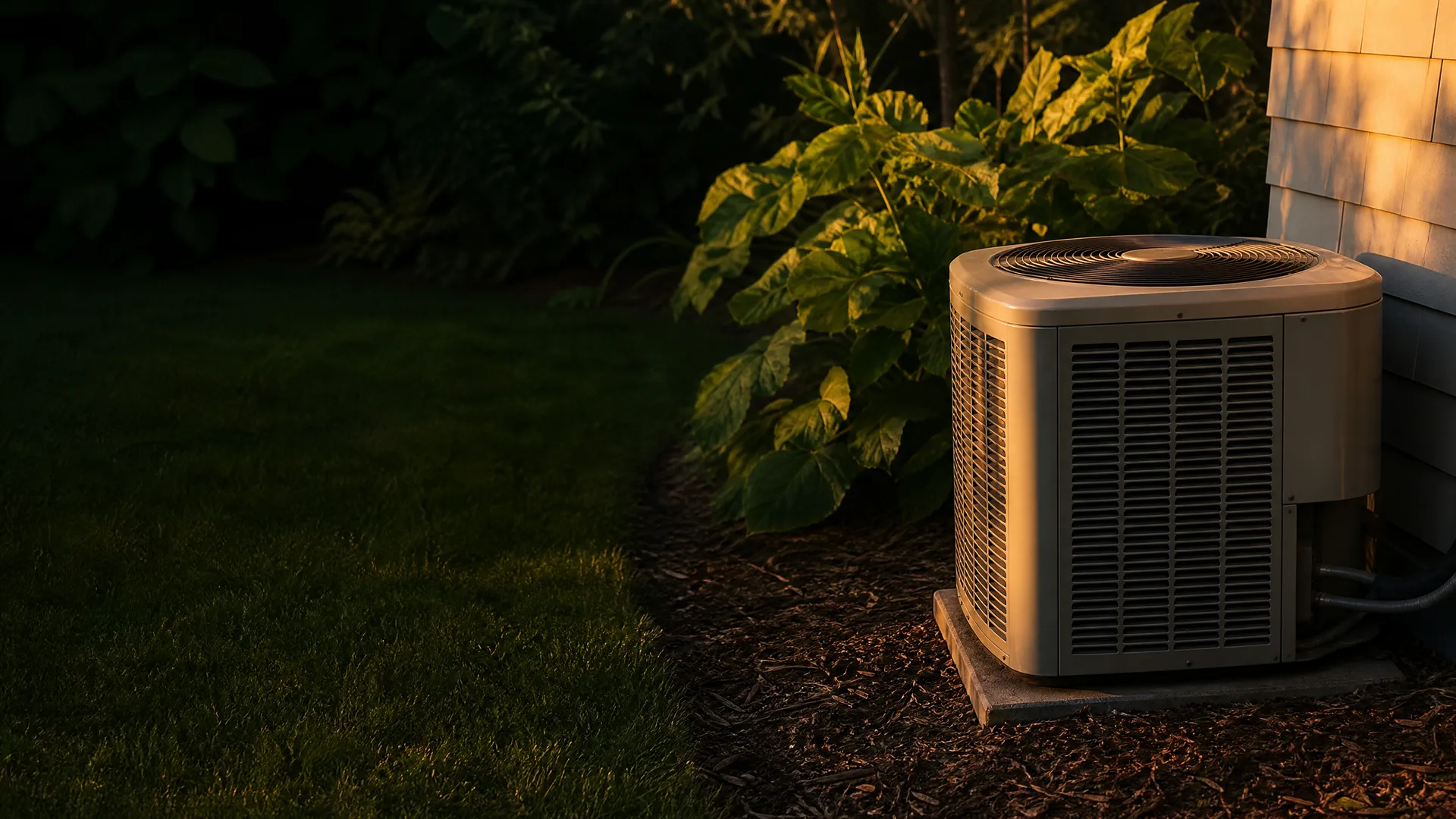
An outdoor air conditioner condenser unit sits on a concrete pad beside a shingled house wall, surrounded by mulch, broad-leaved shrubs and a lawn in low evening light.

You're out back around seven, the grill still warm, and the light has that flat gold look it gets in August. The hum from the condenser stops sounding right. You walk over and see it: the fan on top sitting dead still while the unit keeps running. No blade movement, no breeze coming off the top, just that low electrical sound underneath. You crouch down and feel the side of the cabinet. It's warm, warmer than it should be. Inside, the house is already a few degrees off from where you set it. You stand there a second, listening, before you go back in to check the thermostat.
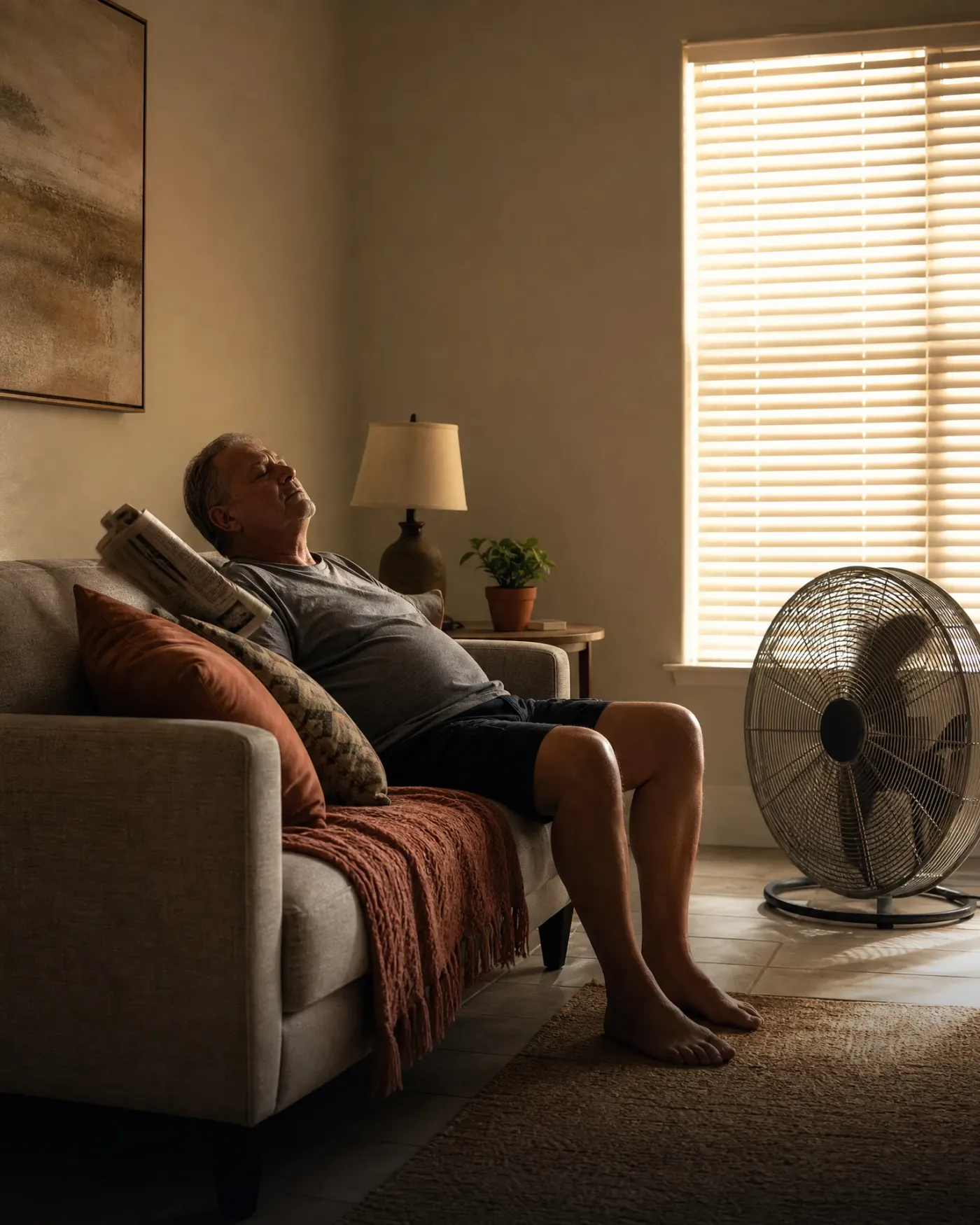

Can the fan just be stuck, or is something actually broken?

You've seen it happen before, or a neighbor's unit does it: the blade stops and a tap or a push gets it going again, at least for a minute. It's a fair question before you call anyone. Sometimes a fan really is just stuck on its bearings, and sometimes what looks stuck is a part that's failed and won't restart no matter how it's nudged.

It can be stuck, but usually something has failed

A fan motor can seize on worn bearings, and that's a real cause, but it's not the common one. Most of the time the motor itself is fine and the capacitor behind it has failed, so the motor gets no start charge and never turns no matter how free the blade spins by hand. A seized motor usually shows other signs too, like a burning smell or a blade that won't turn even when you push it with the power off. If the blade moves freely by hand but the unit won't start it, that points to the capacitor or the motor's wiring, not the bearings. Either way the compressor is still running underneath, so this isn't something to leave alone through a hot New Jersey afternoon.

An outdoor air conditioner condenser unit on a concrete pad beside a house with light horizontal siding, with a small electrical disconnect box on the wall, mulch and shrubs at left, and a plain white wall and concrete slab at right.

Why the motor hums but won't turn

When a capacitor weakens, the motor still gets power but can't build enough torque to start the blade moving. That's the hum. A motor like this can draw close to its full amperage while standing still, which is what pushes it into overheat protection. Some units will click off within minutes of running this way, while others labor longer before a safety switch finally cuts power to protect the windings.

A dark gray outdoor air conditioner condenser unit on a concrete pad beside a house with horizontal siding and a plain light wall, with mulch and grass in the foreground and a conduit and electrical box on the wall.

What a seized bearing sounds like

A fan motor runs on a shaft supported by bearings, and those wear with age and weather. When a bearing seizes, the blade won't move even with a push, and the motor often makes a higher, tighter whine than the low hum of a bad capacitor. Outdoor units in New Jersey take on rain, pollen, and winter salt from nearby roads, all of which work into the bearing over the years and shorten its life.

What are you noticing out there right now

Go look at the unit. If the fan blade is still and the rest of the system is making noise, a humming or buzzing sound, that's the motor trying to start without the help it needs. You might have felt warm air coming from the vents inside, or noticed the house isn't cooling down even though the system seems to be running. Maybe you tapped the side of the unit and the blade kicked on for a minute before quitting again. Left alone, a compressor running without airflow over the coil can overheat and trip off on its own, and repeated shutdowns like that wear on a compressor that's otherwise fine.

A smiling man in a dark navy sweater sits on a light sofa in a living room, with a glass bowl of popcorn on a wooden coffee table and bookshelves behind him.
A smiling man in a dark green sweater sits on a tan leather sofa in a dimly lit living room, with a bowl of popcorn in the foreground and a kitchen area blurred behind him.
A smiling middle-aged man in a dark shirt sits on a gray sofa in a living room, with a bowl of popcorn on a side table and shelves, a window and kitchen area behind him.
A smiling bearded man in a dark gray t-shirt sits on a gray couch in a living room, with a large glass bowl of popcorn on a wooden table in the foreground.

Matched to your air conditioner job

Send it once and finding someone is no longer on you.

No charge to send it. You decide if you hire them.

Letting it run like this for a day or two probably won't total the unit, but it keeps stressing a motor that's already struggling and a compressor that's working harder than it should.

Shutting it off at the breaker until a contractor looks at it costs you comfort for a day, maybe two, against a compressor that still has its full life ahead of it.

An outdoor air conditioning condenser unit on a concrete pad beside a house with horizontal lap siding, with an electrical disconnect box and conduit on the wall, mulch and a green shrub to the right, and a concrete walkway in the foreground.
Before you get your air conditioner repair
A gray outdoor air conditioner condenser unit on a concrete pad beside a house with horizontal siding and a stucco foundation, with a disconnect box and conduit on the wall, decorative gravel, mulch, and a shrub nearby.
After you get your air conditioner repair

Fan off, compressor still running

Heat has nowhere to go. The compressor keeps working against a coil that isn't being cooled, and that's how a stuck fan turns into a bigger repair.

Connect with a pro

Fan off at the breaker

Nothing is running, nothing is straining. The unit sits safe until a contractor can look at the motor and the capacitor behind it.

Connect with a pro

Power costs 22.48 cents per kilowatt-hour statewide

At 22.48 cents a kilowatt-hour, a stalled fan costs you twice. The unit keeps pulling power trying to run, and it's not cooling your house while it does it. Getting the fan fixed instead of left to labor is what keeps that bill from climbing for nothing.

EIA-861 2025 statewide residential average

A gray outdoor air conditioner condenser unit on a concrete pad beside a house with horizontal lap siding, with a flowering shrub at left and a disconnect box with conduit on the wall at right.
A fan like this moves air across the coil all afternoon, keeping pace without a fight.
An outdoor air conditioner condenser unit on a concrete pad beside a house with light horizontal vinyl siding, surrounded by bare dirt, gravel and dry leaves, with refrigerant lines and conduit running along the wall.
Dirt and dead leaves piled against the base tell you the unit has been losing this fight for a while.
A two-story gray horizontal-siding house with multiple gables, a covered front porch with white columns and railing, and a dark front door, fronted by a patchy green and brown lawn under a clear blue sky.

New Jersey summers carry a dew point around 63°F across June, July and August, a figure the National Weather Service tracks for the state. That's heavy air, the kind that sits on you the moment you step outside. Your AC has to pull that moisture out before the house feels right, which means the fan on top and the compressor underneath are both working long hours most afternoons. A system in good shape handles that without issue. One with a weak capacitor or a motor losing strength has less room to cope, and a stalled fan on a day like that leaves the compressor straining against heat and moisture it can't shed.

NASA POWER T2MDEW county cells weighted by homes

A woman in a dark gray sweater reclines on a light sofa with eyes closed and a slight smile, under a textured gray blanket with an open book resting on her lap, with a lit table lamp and plant in the background.
A smiling bearded man in a navy crewneck sweater sits at a dinner table with a glass of red wine, plates and glasses in the foreground, in a dimly lit room with a lamp and framed picture behind him.

What a Stalled Fan Comes Down To

  • A fan that hums but doesn't spin, or sits silent while the unit runs, points to a bad capacitor, a worn motor, or a jammed blade.
  • Shutting the unit off at the breaker stops the compressor from straining against a coil that isn't being cooled.
  • Leaving it running for a day or two probably won't destroy the unit, but it keeps pushing a motor and compressor that are already struggling.
  • A stalled fan still pulls power without cooling your house, which adds up fast at New Jersey's electric rates.
  • Once a contractor is matched to your situation, you're no longer the one tracking down who's available and when.
  • The fix itself is usually straightforward once someone's out there looking at the capacitor, the motor, or whatever's jamming the blade.

A still fan on a running unit almost always traces back to the same handful of culprits: the capacitor, the motor, or something physically blocking the blade. None of those are mysteries once a contractor has eyes on the unit. The breaker is there for a reason in the meantime. Flipping it off doesn't fix anything, but it stops the compressor from working against a coil that isn't getting any airflow, and that's the part of this that actually gets more expensive the longer it goes on. A day or two won't likely total the system, but there's no upside to letting a struggling motor keep struggling, and there's no upside to paying New Jersey's rates to run a unit that isn't cooling anything.

The practical part of this is simpler than it feels standing out there listening to the hum. Someone qualified needs to look at the capacitor, test the motor, or clear whatever's jamming the blade, and that part of the job tends to move fast once it starts. What takes the time, usually, is finding that person. That's the piece this page hands off. Once you send the request, you're not the one calling around or waiting on hold to find out who's free this week. A contractor who handles this gets matched to your situation, and they reach out. The unit sitting there running hot and loud is a problem with a known shape. Getting it looked at is the straightforward part.

Elevated view over a dark standing-seam metal roof with a stone chimney and wood-sided gable, surrounded by conifers and autumn-colored trees with forested hills under an overcast sky.

A local pro for your air conditioner repair

Find a pro near me

You only hire the pro if you want to.

A stalled fan doesn't fix itself, and every afternoon it runs like that is another afternoon the compressor strains against a coil with nowhere to put its heat. Sending the request now means a contractor takes it from here, and you're not the one tracking down who's free to look at it.